Population Health Forecasting
Using data analytics, trend analysis, and predictive modeling to identify emerging health challenges and opportunities.
Turning Research into Action. Transforming Communities Through Knowledge, Innovation, and Service.

The Institute for Translational Population Health Research (ITPHR) serves as the research, innovation, and community impact arm of First United Refuge Church. Located adjacent to the church at 161 DeWitt Avenue in Elmira, New York, the Center was established to bridge the gap between research and real world practice by developing evidence based solutions that improve health, well being, and quality of life.
Our work is guided by a simple belief.
Research should improve lives.
Too often, valuable research remains confined to academic journals, conference presentations, and institutional reports. At the Translational Population Health Research Center, we are committed to translating knowledge into practical programs, policies, and interventions that create measurable community impact.
The mission of the Translational Population Health Research Center is to generate, translate, and apply research that improves population health, strengthens communities, and reduces health disparities.
We work at the intersection of:
Population level approaches that prevent disease and promote well being.
Strengthening neighborhoods, organizations, and civic infrastructure.
Mental, emotional, and social pathways to resilience.
Partnering with congregations as trusted community anchors.
Closing gaps for vulnerable and underserved populations.
Housing, education, food, and the conditions that shape health.
Predictive modeling that anticipates risks and opportunities.
Programs designed alongside the people they serve.
Our goal is not simply to study problems. Our goal is to help solve them.
Translational Population Health focuses on moving scientific knowledge into practical application. Instead of asking one question, we ask another.
What can we publish?
What can we improve?
This approach allows us to work directly with communities, healthcare organizations, faith communities, policymakers, educators, and local leaders to create sustainable solutions to complex challenges.
Where we direct our questions, methods, and partnerships to produce the greatest community impact.
Using data analytics, trend analysis, and predictive modeling to identify emerging health challenges and opportunities.
Improving mental health, emotional well being, resilience, and community support systems.
Identifying and addressing disparities that affect vulnerable and underserved populations.
Examining how housing, education, transportation, food access, employment, and social environments influence health outcomes.
Developing innovative approaches to housing stability, recovery, and community wellness.
Helping communities prepare for and respond to social, economic, and public health challenges.
Connecting individuals to community resources and activities that support health and well being beyond traditional healthcare.
Elmira faces many challenges that communities throughout America are experiencing, including:
Rather than viewing these challenges as barriers, we view them as opportunities for innovation, collaboration, and transformation. The Center works alongside residents, organizations, healthcare providers, educational institutions, and community leaders to develop practical solutions that improve lives.
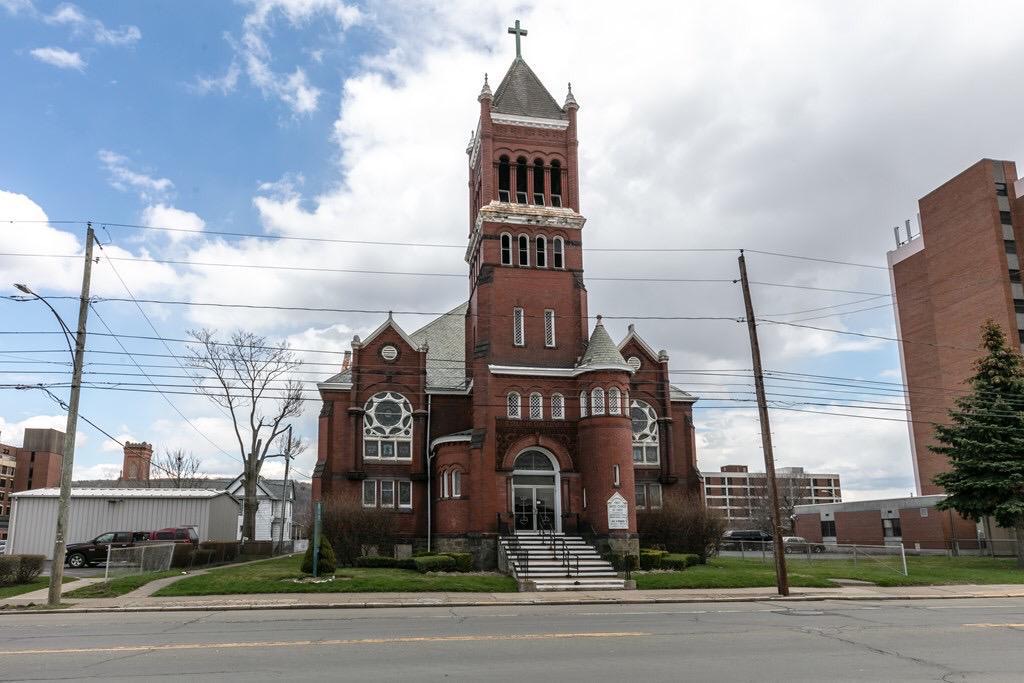
The Translational Population Health Research Center operates in partnership with First United Refuge Church. Together, we believe that faith communities can play an important role in improving community well being.
This unique partnership allows us to address both the spiritual and practical dimensions of human flourishing.

Our approach emphasizes collaboration. Community members are not merely participants. They are partners.
We believe the people closest to community challenges are often closest to the solutions. Through community based participatory research, we work with residents to identify priorities, develop interventions, and evaluate outcomes.
The Center is actively exploring innovative approaches and scalable models that can be replicated throughout New York State, across the United States, and internationally.
Trusted neighbors connecting people to care and support.
Linking individuals to non clinical, community based supports.
Neighborhood places of care, connection, and learning.
Real time dashboards that surface community health signals.
Predictive tools that help leaders act before crises grow.
Stable housing paired with whole person care coordination.
Open data tools that help neighborhoods see themselves clearly.
Public health collaborations rooted in trusted faith networks.
Complex challenges require collaborative solutions. We welcome collaboration with:
Research collaboration and student engagement.
Clinical integration and shared population health goals.
Community level prevention and policy work.
Trusted neighborhood partners on the ground.
Policy, data sharing, and scaled implementation.
Catalytic funding for community innovation.
Trusted networks for whole person care.
Field placements, fellowships, and joint projects.
Together, we can create meaningful and lasting change.
For detailed information about our research programs, projects, publications, partnerships, and initiatives, explore our dedicated research website.
Through innovation, collaboration, and community engagement, the Translational Population Health Research Center is working to build that future. One project, one partnership, and one community at a time.